Why bother, if it is already rented
Three reasons, and they are all financial as well as legal.
Insurance. An unpermitted suite can complicate or invalidate a claim, and the claim you care about is the large one. If a fire starts in an unpermitted unit, the conversation with your insurer is not one you want to be having.
Enforcement. An unpermitted suite can be ordered closed. That usually follows a complaint, which means the risk is outside your control and arrives without warning.
Resale. An unpermitted suite has to be disclosed, and it moves from being a selling feature to being a liability that buyers discount or ask you to remove. A registered suite does the opposite.
Timing is currently relevant
Calgary has operated an amnesty arrangement for owners of un-permitted suites coming forward to legalise them, with an end date that has been set at 31 December 2026. Amnesty periods are designed to bring existing units into compliance without penalising owners for coming forward, which makes them the cheapest window in which to do this.
Deadlines and terms do change, so confirm the current position with the City of Calgary before you rely on it. But if the arrangement is still open when you read this, it is the moment to act rather than wait.
What the assessment looks at
Legalising starts with finding out what you already have. The assessment covers the same list any legal suite has to satisfy:
- Ceiling height. Checked first, because it is the one item that cannot be designed around.
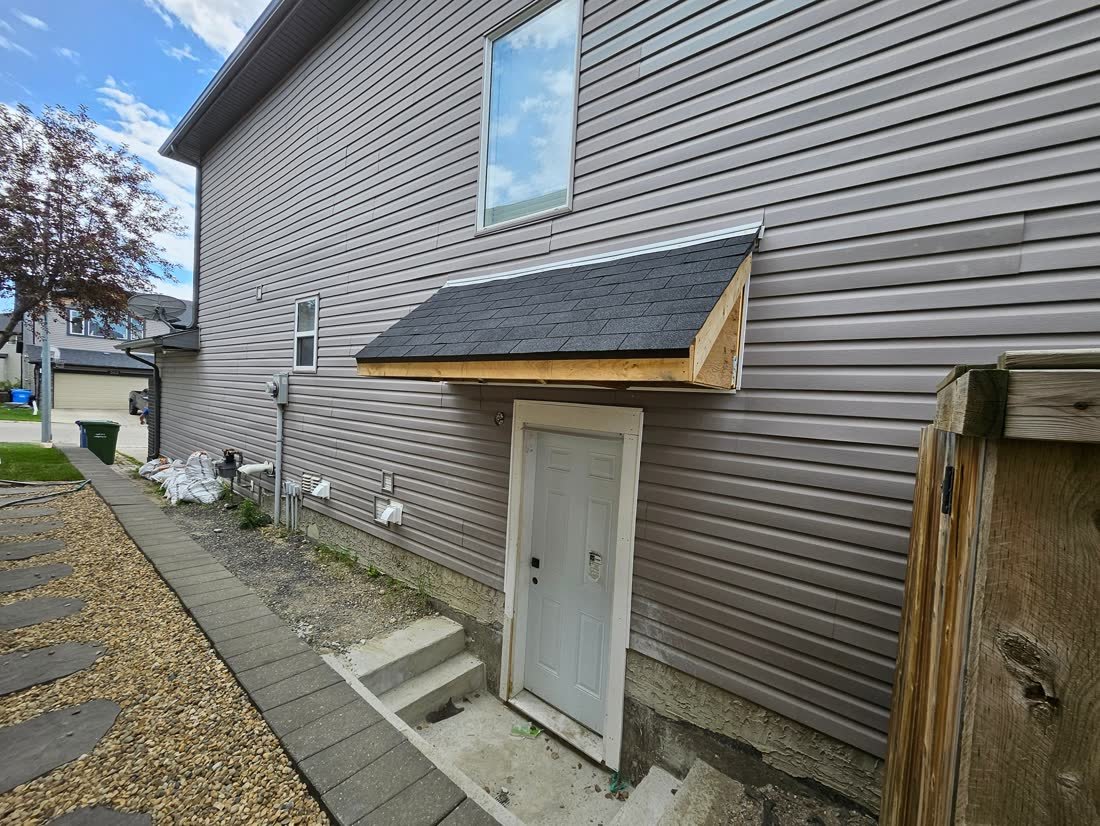
- The entrance. Whether there is a compliant separate entrance, and whether one can be built if not.
- EGRESS WINDOW openings. Measured in every room being used as a bedroom. This is the most common gap.
- Fire separation. Almost always the largest piece of work, because it is invisible and therefore rarely present in unpermitted conversions.
- Alarms. Interconnected smoke and carbon monoxide alarms across both units.
- Mechanical and electrical. Heating, ventilation, extraction ducted outside, and dedicated circuits with adequate panel capacity.
The usual findings
In our experience the recurring gaps are undersized bedroom windows, missing or incomplete fire separation, extraction fans venting into the joist space instead of outside, and electrical that was extended rather than properly circuited.
None of those are unusual and none are automatically fatal. They are simply the things that get skipped when work is done without inspection, because they are the things nobody sees once the drywall is up.
Start with an honest assessment. We will look at your existing suite and tell you plainly what it needs, what it would cost as a fixed quote, and whether it is worth doing on your property. Free, and with no obligation. Call 587 439 5191 or see legalising an existing basement.
What it is not
Legalising is rarely a demolition. In most cases the layout survives, the kitchen and bathroom survive, and the work concentrates on the safety systems and the openings. What it does mean is opening up specific areas so the hidden work can be corrected and inspected, then making good afterwards.
That is the trade. Some disruption now, in exchange for a suite you can insure, advertise and sell with the paperwork to prove it.
Frequently asked
Can every unpermitted basement suite be legalised?
Not every one. Finished ceiling height is the usual hard stop, since it cannot be changed without underpinning or lowering the slab. Entrance feasibility and whether window openings can be enlarged are the next two. Those get checked first.
Will I have to stop renting during the work?
Usually the unit needs to be vacant for the construction period, since the work involves opening up fire separations and electrical. The duration depends on how much of the list needs correcting, and you get that timeline with the fixed quote.
Is legalising cheaper than building a new suite?
Often, but not always. If the layout, the entrance and the window openings are already close to compliant, it is considerably cheaper. If all three need correcting, the cost approaches new build, and the assessment tells you which situation you are in.